
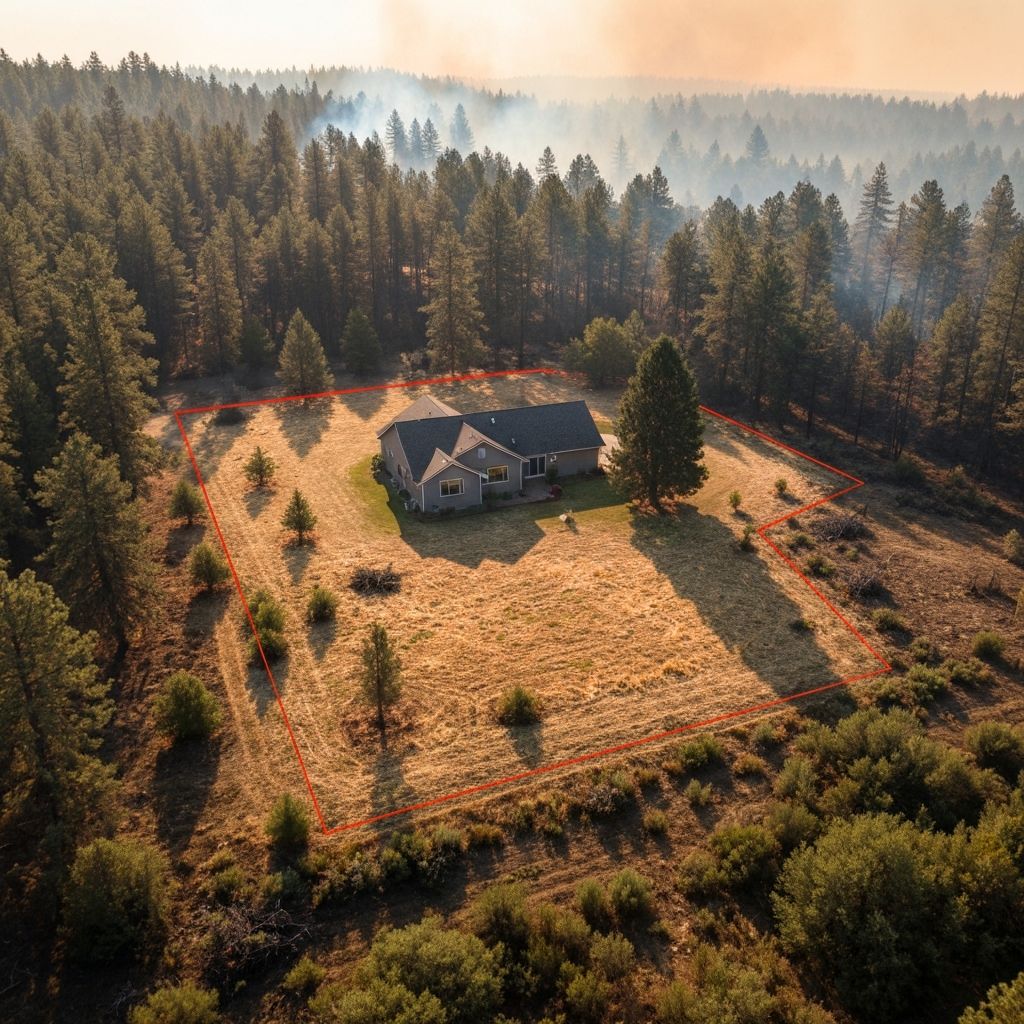
Most homes that burn in a wildfire aren't hit by the main flame front. They're ignited by wind-blown embers that land on something flammable next to the house. That's why the work you do on the ground around your home, and on a handful of weak spots on the building, matters so much.
This page walks through a practical prep checklist, starting with the part of the job that is land work and moving outward from the house. It's based on the Wildfire Prepared Homeprogram's how-to checklist, which sets out the steps to prepare a home for wildfire. We've summarized it in our own words for Central Oregon landowners. The full checklist, eligibility rules and the application process are at wildfireprepared.org.
Byrd Land Co. is not affiliated with the Wildfire Prepared Home program and can't designate a home. We do the land-side work that gets a property ready.
The idea: protect the weakest link
Wildfire finds the easiest way in. A home with a fire-rated roof but dry needles in the gutters, or a clean yard but a wood fence touching the siding, is still vulnerable. The program groups the work into two levels:
- Base (Essential):protection from embers, the leading cause of home ignitions. It's aimed at most existing homes.
- Plus (Enhanced):adds protection from flames and radiant heat. It's mostly for new construction, major exterior remodels, or owners with higher resilience goals.
This page focuses on Base-level steps, since that's where most existing homes should start.
Zone 1: 0–5 feet from the house (the noncombustible zone)
This is the most important five feet on your property. Measure outward from the walls, and from the edge of any attached deck, patio, stairs or other attached feature. Nothing that can burn should be in this zone or hanging over it.
- Remove all vegetation down to bare soil, including grass, weeds, flowers, shrubs and vines. Irrigated or "fire-resistant" plants don't get an exception.
- Remove trees, and any limbs that overhang this area.
- Replace bark, wood chips, rubber mulch, pine needles and artificial turf with gravel, pavers, river rock, decomposed granite or concrete.
- Replace wood or vinyl fencing, gates and retaining walls within 5 feet with metal or concrete.
- Move vehicles, RVs, boats, ATVs and other equipment out of this zone.
- Clear out firewood, wood or plastic furniture, large rugs, plastic rain barrels and similar items. If you want furniture here, choose metal-framed pieces.
Items you move around (grills, trash bins, hoses, doormats, toys) should go indoors, or at least 30 feet away, when a Red Flag Warning is in effect or when you'll be away for a while.
Zone 2: 5–30 feet from the house (the fuel reduction zone)
This zone is about slowing a fire down and starving it of a continuous path to your home. Work out to 30 feet, or to the property line if that's closer.
- Trees:prune the lowest branches to at least 6 feet off the ground (or one-third of the tree's height for trees under 18 feet). Keep branches 10 feet away from chimneys and stovepipes.
- Shrubs: keep groups to 10 feet wide or less, and space them at least twice the height of the tallest plant, up to a maximum of 10 feet. Remove shrubs and plants taller than 2 feet from beneath trees.
- Hedges and rows: keep continuous hedges or rows of shrubs at least 10 feet from the house.
- Grass: mow to under 4 inches. On slopes where you need erosion control, the guideline allows up to 18 inches.
- Dead material: regularly clear dead or dying plants, branches, stumps, logs, leaves and pine needles.
- Firewood:stack it at least 30 feet from the home, or store it in an approved outbuilding. Don't rely on a tarp.
Decks, sheds and other things within 30 feet
If you have decks, patios, pergolas, sheds, carports, playsets or an ADU within 30 feet, they count too.
- Keep detached structures at least 10 feet from the house and from each other, and limit to three detached structures within 30 feet.
- Keep decks and patio surfaces clear of needles, leaves and debris. Skip planter boxes and climbing vines.
- Don't use the space under decks or sheds for storage.
- Enclose low decks (4 feet or less) with 1/8-inch corrosion-resistant metal mesh.
- Keep hot tubs at least 10 feet from the house and out from under combustible overhead structures.
- Locate propane tanks at least 30 feet away, or at least 10 feet away with a cleared, noncombustible area around the tank.
The building itself
These steps are on the house, not the land. Most of them are a job for a roofer, siding contractor or general contractor.
- Roof: a Class A fire-rated covering such as asphalt shingles, tile, slate or metal. Keep it clear of needles and debris.
- Gutters: noncombustible gutters and downspouts, cleaned regularly.
- Siding base: at least 6 inches of noncombustible material (concrete foundation, stucco, fiber-cement, metal flashing) at the bottom of exterior walls and above attached decks.
- Vents:ember-resistant vents, or 1/8-inch corrosion-resistant metal mesh over existing roof, attic, eave and foundation vents. Dryer vents should have a working flap or louver and shouldn't get mesh, which traps lint.
Homes aiming for the Plus level go further, with enclosed eaves, tempered-glass windows, solid-core or noncombustible doors, noncombustible siding and decks, and no structures within 30 feet. See the official checklist for the details.
What we can do for you
The first two zones are heavy on vegetation work, which is what we do all day:
- Defensible space creation and maintenance for Zones 1 and 2, including thinning, limbing and ladder fuel removal
- Brush clearing and forestry mulching for larger lots and acreage
- Slash and burn pile removal so cleared material isn't left sitting on the property
- Fuel breaks and access roads for properties with more acreage
We don't do roofing, siding or vents. If your assessment turns those up, we'll tell you so, and you'll want a licensed contractor for that part. For pricing on the land work, our cost guides are a good starting point.
Get a free site assessment
Not sure where your property stands? We'll walk it with you, identify the highest-risk spots, and give you a phased plan. Schedule a free assessment or give us a call.
Serving Bend, Redmond, Sisters, Sunriver, La Pine, Prineville, Madras, Tumalo, Terrebonne and surrounding Central Oregon communities.
Source: This page summarizes the Wildfire Prepared Home “How-To Prepare Checklist.” Requirements may be updated; always check wildfireprepared.orgfor the current version. This page is general information and doesn't replace guidance from your local fire agency, insurer or a licensed contractor.
Frequently Asked Questions
Where should I start?
Start at the house and work out. Clear the first 5 feet, deal with gutters and roof debris, then work on the 5–30 foot zone.
Do I need to do all of it?
The program's designation requires the full set of Base requirements. Even if you're not applying, finishing the highest-impact items first (Zone 1, roof and gutter debris, vents) reduces risk.
Is defensible space required where I live?
Requirements depend on your location and fire district. Check with your local fire agency or county before you start. Bend Fire & Rescue and the Oregon State Fire Marshal offer free defensible space assessments.
How much will it cost?
It depends on acreage, terrain and how much material has built up. Our cost guides on the blog are a starting point, and a site visit gives you a real number.